How much does the tooth fairy pay these days?
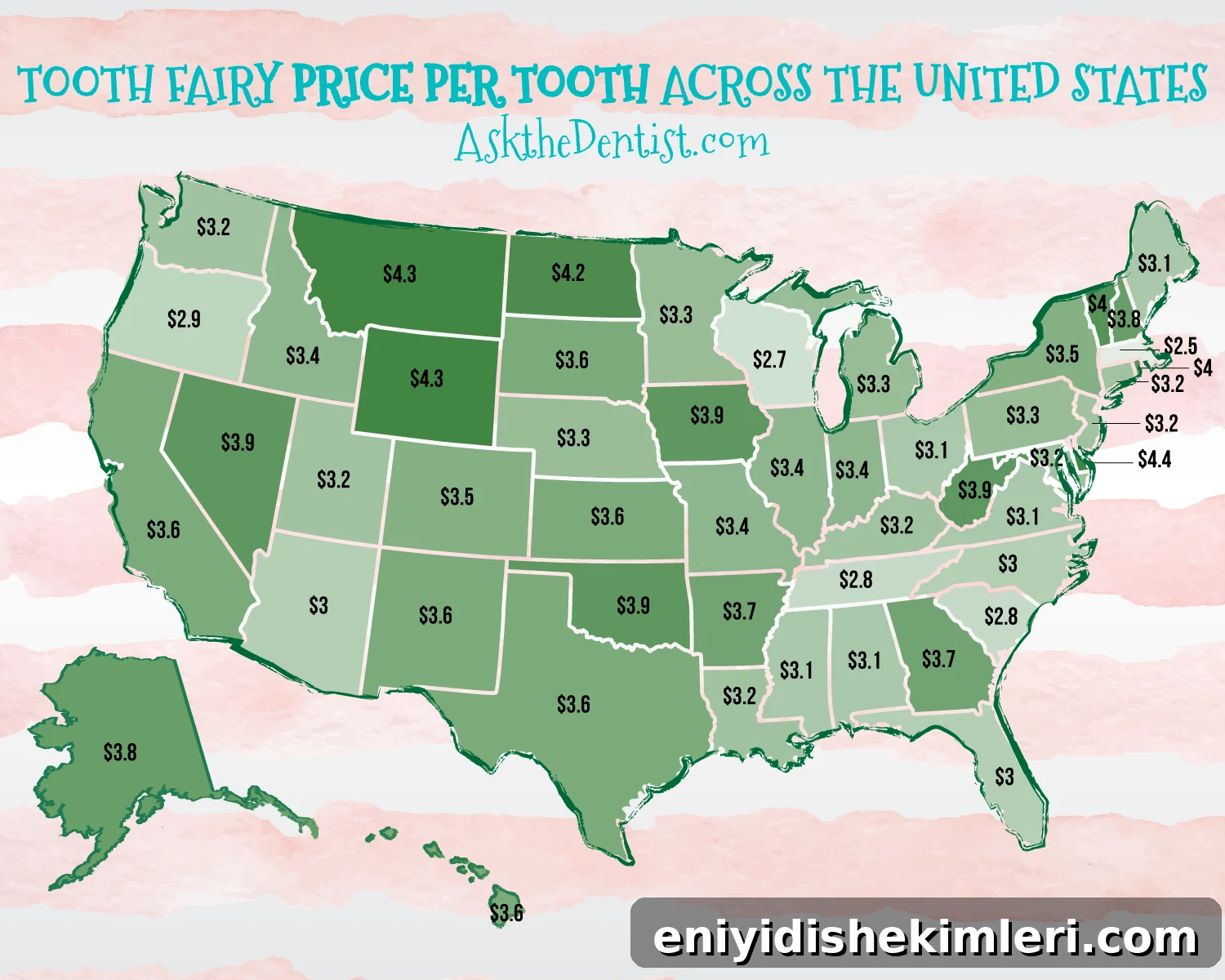
We surveyed more than 1,700 parents across the United States to determine the average amount the tooth fairy leaves per lost tooth in each state.
Here’s what we discovered.
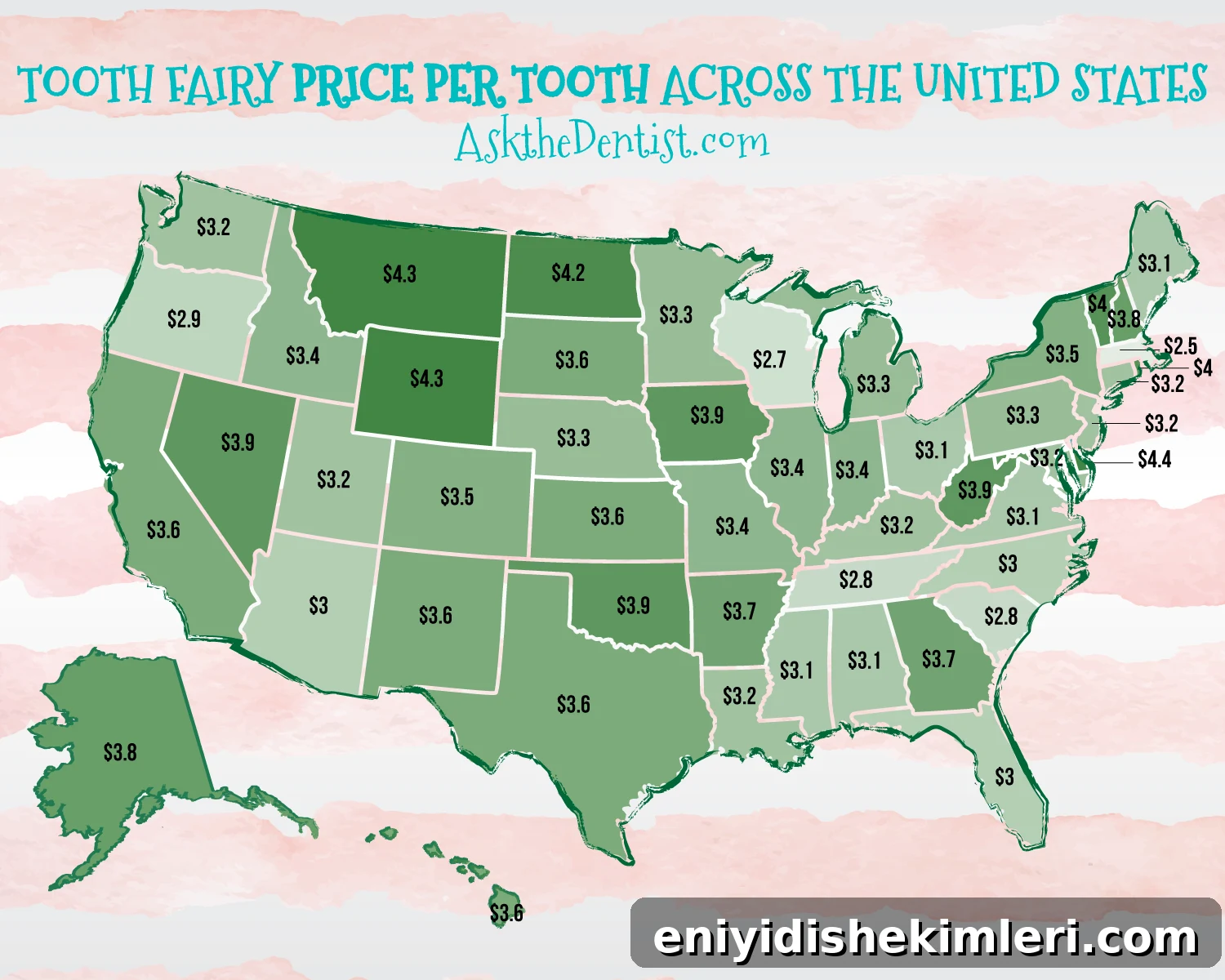
| State | Average Payout |
| Alabama | 3.08 |
| Alaska | 3.83 |
| Arizona | 2.97 |
| Arkansas | 3.72 |
| California | 3.61 |
| Colorado | 3.47 |
| Connecticut | 3.23 |
| Delaware | 4.46 |
| District of Columbia | 3.71 |
| Florida | 2.97 |
| Georgia | 3.70 |
| Hawaii | 3.57 |
| Idaho | 3.36 |
| Illinois | 3.41 |
| Indiana | 3.42 |
| Iowa | 3.91 |
| Kansas | 3.62 |
| Kentucky | 3.20 |
| Louisiana | 3.22 |
| Maine | 3.06 |
| Maryland | 3.20 |
| Massachusetts | 2.56 |
| Michigan | 3.33 |
| Minnesota | 3.29 |
| Mississippi | 3.12 |
| Missouri | 3.43 |
| Montana | 4.35 |
| Nebraska | 3.27 |
| Nevada | 3.93 |
| New Hampshire | 3.77 |
| New Jersey | 3.21 |
| New Mexico | 3.60 |
| New York | 3.53 |
| North Carolina | 2.97 |
| North Dakota | 4.15 |
| Ohio | 3.11 |
| Oklahoma | 3.86 |
| Oregon | 2.87 |
| Pennsylvania | 3.28 |
| Rhode Island | 4.02 |
| South Carolina | 2.75 |
| South Dakota | 3.62 |
| Tennessee | 2.80 |
| Texas | 3.56 |
| Utah | 3.25 |
| Vermont | 3.98 |
| Virginia | 3.12 |
| Washington | 3.23 |
| West Virginia | 3.86 |
| Wisconsin | 2.74 |
| Wyoming | 4.33 |
Sample details
The survey included only U.S. residents who are parents of children under 13. Respondents were recruited from every state, with an average of roughly 35 participants per state. The age distribution aligns with typical U.S. parent demographics: 15% were ages 18–27, 56% were 28–37, 24% were 38–47, and 5% were 48 or older. Gender distribution was balanced, with 46% male and 54% female respondents. To improve data quality, the fastest 5% of submissions were removed before analysis, resulting in a final sample of 1,788 participants. Respondents were compensated at a rate equivalent to at least $15 per hour.
Methodology
Participants reported how much the tooth fairy typically leaves per lost tooth in their households. To estimate state-level averages reliably, we used a linear mixed-effects regression model. This method pools information across states while accounting for the number of observations in each state, producing more stable estimates than simple state-level means alone. The pooled estimates closely match simple means but are less susceptible to variability in states with small samples. Both pooled estimates and simple means are highly correlated; we present the pooled estimates as the primary results while acknowledging simple means as a straightforward alternative.