
Hearing that you need dental surgery can feel overwhelming at first.
With many procedures and treatments in oral and maxillofacial surgery, it’s normal to have questions. You may be wondering about average costs, available options, how to prepare, and ways to speed recovery.
This article explains 12 common types of dental surgery, why each may be needed, typical costs and recovery timelines, and practical steps to prepare before and recover after surgery.
I’ll also cover common questions I hear as a dentist and guidance for choosing the right surgeon. Take a deep breath — the goal is to move you from anxious to informed.
Reasons for Oral and Dental Surgery
Oral surgery is recommended for many different reasons. Some procedures address damage from gum disease or tooth decay. Others repair facial trauma, remove impacted wisdom teeth, treat jaw misalignment, or diagnose and remove suspicious growths. Below, each procedure is explained with typical reasons and outcomes.
12 Types of Dental Surgery
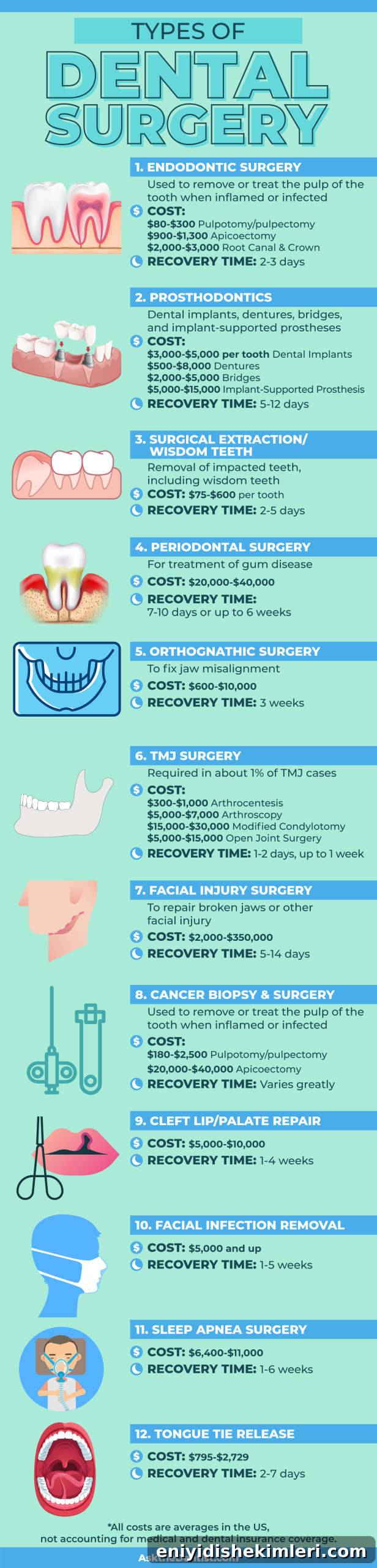
Classification of oral and dental surgery varies across sources, which can be confusing. Below is a clear list of 12 procedure types with average costs and recovery expectations. Note that the prices are national averages without insurance—your exact cost will depend on your location, specific needs, and the provider.
1. Endodontic Surgery
Cost:
- $80–$300 for a pulpotomy/pulpectomy
- $900–$1,300 for an apicoectomy
- $2,000–$3,000 for a root canal and crown
Reasons: Pulpitis that can be partially treated with a pulpotomy/pulpectomy, deep infection requiring a root canal, or a failed root canal that needs an apicoectomy to remove an infected root tip.
Recovery: A few days of pain and inflammation that gradually improve. A day off work is often recommended.
Endodontic surgeries treat infections or decay that extend past the enamel and cannot be resolved with fillings. These procedures are common and effective at saving teeth when performed promptly.
2. Prosthodontics
This category covers tooth replacement options: dental implants, dentures, bridges, and implant-supported prostheses.
Dental Implants
Cost: $3,000–$5,000 per tooth. Bone grafting, if needed, can add $200–$1,000.
Reasons: To replace missing teeth, preserve the jawbone, prevent shifting, and restore a long-term chewing and aesthetic solution.
Recovery: Swelling typically subsides in 5–7 days; normal activities often resume after two days. Implants require multiple visits and healing time between steps.
Implants have high long-term success rates and are often the preferred option when natural teeth cannot be saved.
Dentures
Cost:
- Full dentures: $1,000–$4,000
- Premium dentures: about $8,000
- Partial dentures: $500–$1,500
Extractions add roughly $75–$450 per tooth.
Reasons: When many or all natural teeth are not salvageable and a full or partial replacement is needed.
Recovery: Extraction sites heal in 7–10 days; adapting to dentures takes several weeks.
Dentures are a more affordable option for extensive tooth loss, though they can require adjustments and an adaptation period.
Bridges
Cost: $2,000–$5,000
Reasons: To fill the gap left by a missing tooth and prevent shifting or bite issues.
Recovery: Several visits are required. Soreness and swelling from extractions take 5–7 days to ease; crown and bridge placement usually cause a day or two of mild discomfort each.
Bridges are a reliable option when adjacent teeth are healthy enough to support the restoration.
Implant-Supported Prosthesis
Cost:
- Implant-supported bridges: $5,000–$15,000
- Implant-supported dentures: $10,000–$15,000, depending on materials
Reasons: A more permanent, stable solution that combines implants with bridges or dentures.
Recovery: Similar to implants, with about 7–10 days for swelling and initial healing; full integration takes longer.
These prostheses are more durable and comfortable but require a larger upfront investment.
3. Surgical Extraction and Wisdom Teeth
Cost: $75–$200 per typical tooth; $225–$600 per impacted tooth.
Reasons: Impacted or misaligned wisdom teeth, broken or decayed teeth beyond repair, or teeth causing crowding and shifting.
Recovery: Wisdom tooth removal: 3–5 days if uncomplicated; simple extractions: 2–3 days for initial discomfort, with longer healing of the socket.
Extractions are often followed by discussion of replacement options, with implants commonly recommended to restore function.
4. Periodontal Surgery
Cost:
- Gum graft per tooth: $600–$1,200
- Pinhole surgery: $4,000–$10,000 depending on extent
- Flap surgery/pocket reduction: $1,000–$3,000
Bone grafting, when required, can add $200–$1,000.
Reasons: Treating deep tartar, receding gums, and periodontal pockets caused by gum disease.
Recovery: 7–10 days for flap surgery and grafts; pinhole techniques may take up to six weeks for full recovery.
Periodontal procedures work beneath the gum line to halt disease progression, save teeth, and restore healthier gum and bone support.
5. Orthognathic (Corrective Jaw) Surgery
Cost: $20,000–$40,000 depending on complexity and whether one or both jaws are involved.
Reasons: Severe jaw misalignment affecting chewing, breathing, speech, pain, or sleep.
Recovery: Initial recovery about three weeks; full healing and orthodontic follow-up extend longer.
This surgery repositions the jawbones, often without external scars, and is typically coordinated with orthodontic treatment.
6. TMJ Surgery
Cost:
- Arthrocentesis: $300–$1,000
- Arthroscopy: $5,000–$7,000
- Modified condylotomy: $15,000–$30,000
- Open joint surgery: $5,000–$15,000
Reasons: Severe jaw pain, limited movement, lockjaw, or persistent dysfunction not relieved by non-surgical treatments.
Recovery: Arthroscopy or arthrocentesis: 1–2 days before returning to light work; open surgery or condylotomy: about a week of initial recovery.
Surgery is reserved for severe TMJ disorders after conservative therapies have failed.
7. Facial Injury Surgery
Cost: Varies widely: from about $2,000 for a broken jaw to much higher amounts for extensive facial reconstruction.
Reasons: Traumatic injuries — fractures, avulsed teeth, palate damage — that require surgical repair to restore function and appearance.
Recovery: Swelling decreases in 5–7 days; bruising fades over 10–14 days; full recovery can take several months depending on severity.
Facial trauma is often an emergency and should be treated promptly to avoid lasting complications.
8. Head, Neck, and Oral Cancer Biopsy and Surgery
Cost:
- Biopsy: $180–$2,500 depending on method
- Surgery for oral cancer: commonly $20,000–$40,000 depending on location and stage
Reasons: To diagnose suspicious lesions and remove cancerous tissue; treatment plans vary by stage and location.
Recovery: Varies widely. Biopsy recovery is usually within a week; larger cancer surgeries require longer recovery and possible follow-up treatments.
Treatment may involve surgery, radiation, and reconstruction depending on the extent of disease.
9. Cleft Lip and Palate Repair
Cost: $5,000–$10,000 per procedure; repairs are often staged, so multiple surgeries may be required.
Reasons: Congenital failure of the lip or palate to fuse properly during fetal development, affecting feeding, speech, hearing, and dental development.
Recovery: Swelling improves in 1–2 weeks; incisions typically heal in about four weeks.
Early repair and coordinated care with pediatric specialists and orthodontists improve long-term outcomes.
10. Facial Infection Removal
Cost: Typically $5,000 and up, depending on severity and required treatment.
Reasons: Serious soft tissue infections or abscesses that can threaten airway or spread systemically if not treated.
Recovery: 1–5 weeks depending on severity and the need for additional therapies such as antibiotics or drainage.
Facial infections can arise from dental abscesses, fungal overgrowth, or other sources and require prompt treatment.
11. Sleep Apnea Surgery
Cost: $6,400–$11,000
Reasons: Obstructive sleep apnea causing airway collapse, stopped breathing during sleep, or cardiovascular risks when conservative therapies have failed.
Recovery: 1–2 weeks to resume most activities; 3–6 weeks for fuller recovery. Hospital observation is often required for a few days depending on the procedure.
Procedures target structures contributing to obstruction such as the tongue base, soft palate, or jaw position, and are tailored to the individual.
12. Tongue-Tie Release
Cost: $795–$2,729 for a frenectomy; higher for frenuloplasty if a more involved repair is needed.
Reasons: Restricted tongue movement (ankyloglossia) that affects feeding, speech, oral posture, or contributes to jaw pain and bruxism.
Recovery: 2–7 days for wound healing.
Release is usually simple, using a laser or scalpel, and is often combined with myofunctional therapy to improve long-term function.
Choosing a Surgeon
Selecting the right surgeon is important. Consider these points:
- Check insurance coverage to reduce out-of-pocket cost, and compare fees within your network if possible.
- For complex procedures, choose a surgeon certified by the American Board of Oral and Maxillofacial Surgery or a similarly accredited board when applicable.
- Ask your dentist for referrals; they often have experience working with local specialists.
- During consultation, evaluate the surgeon’s recommendations, communication style, and how comfortable you feel asking questions.
- Look for a specialist with expertise relevant to your specific condition.
Preparing for Dental Surgery
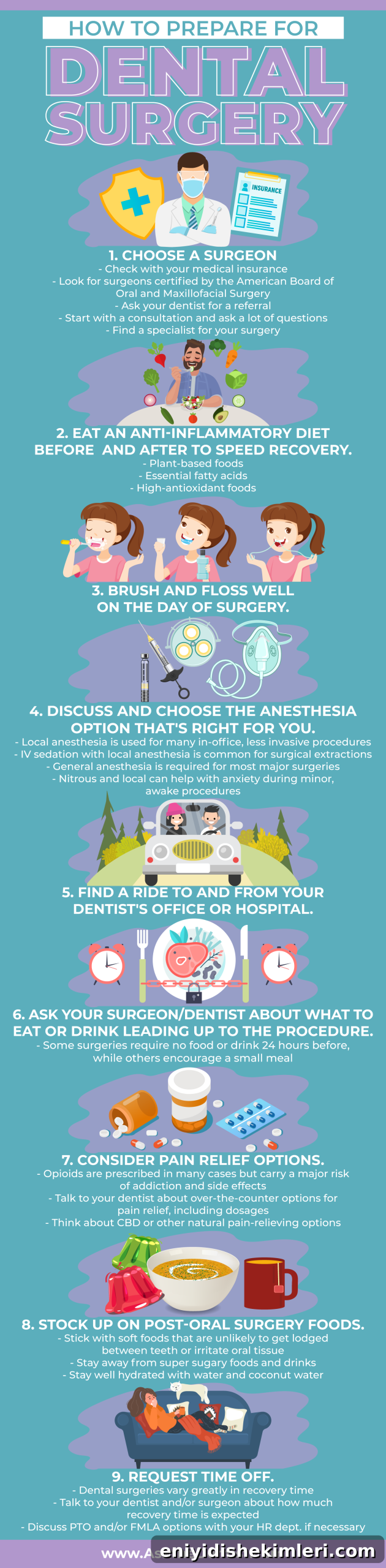
Good preparation improves outcomes. Overall health, nutrition, and oral hygiene matter. An anti-inflammatory diet rich in whole grains, fruits, vegetables, omega-3 fatty acids, and antioxidant foods can reduce systemic inflammation and support healing.
Maintain excellent oral hygiene leading up to surgery by brushing and flossing properly, and follow any preoperative instructions from your surgeon. Reducing inflammation and oral bacterial load lowers complication risk.
Anesthesia: Types and Preparation
Anesthesia options include:
- Local anesthesia — for smaller procedures; recovery is typically quick.
- IV sedation — reduces consciousness and memory of the procedure; used with local anesthesia for more complex or multiple procedures.
- General anesthesia — used for major surgeries; you will be fully unconscious and may require longer monitoring.
- Nitrous oxide with local — an option for anxious patients that wears off quickly.
Discuss anesthesia choices with your surgeon. Factors that inform the plan include the procedure’s complexity, your health, medications, and any special considerations.
Recovery After Dental Surgery
Preparation sets the stage for smoother recovery. Follow your surgeon’s instructions, be realistic about recovery time based on the procedure, and plan for rest and limited activity as needed.
Day of Surgery
Arrange a ride home if you receive sedation or general anesthesia. Follow fasting instructions for sedation. Take or skip routine medications only as directed by your surgeon. Wear comfortable clothing and arrive with a clean mouth.
After Surgery
Expect some swelling, bruising, and discomfort. Avoid spitting, swishing, sucking on straws, or smoking, as these actions can dislodge clots or interfere with healing. Follow guidance about permitted oral hygiene practices for the first few days.
If prescribed opioids, use them only as directed and for the shortest period necessary; discuss alternatives for pain control with your provider.
Tips for Faster Recovery
- Stay hydrated with lukewarm water or electrolyte-rich fluids.
- Avoid strenuous activity that could cause bleeding or dislodge clots.
- Stick to soft or liquid foods until cleared to resume chewing.
- Monitor for warning signs — fever, pus, unusual bleeding, or increasing swelling — and contact your surgeon promptly if they occur.
Oral Surgeon Specialties
Oral and maxillofacial surgeons receive extensive training. Subspecialty fellowships can include head and neck cancer, craniofacial and pediatric maxillofacial surgery, and cranio-maxillofacial trauma. Training typically involves years of dental school and residency, with additional fellowship training for some specialties.
Emergency Dental Surgery
Seek immediate care or go to the emergency room for:
- Knocked-out teeth
- Fractured jaws from trauma
- Jaw dislocation
- Severe oral cuts or uncontrollable bleeding
- Abscesses or infections causing swelling, fever, or breathing difficulties
FAQs
Q
Will I need antibiotics before dental surgery?
A
It depends on the procedure and your oral and medical health. Antibiotics are more likely when infection risk is higher, such as with certain extractions, or for patients with specific medical conditions. Your surgeon will advise based on your case.
Q
Is a dental surgeon the same as an oral surgeon?
A
A dentist performs many surgical procedures and serves as the general oral health practitioner, while an oral and maxillofacial surgeon is a specialist who completes additional training focused on surgeries of the jaws, face, and related structures.
Q
Is oral surgery painful?
A
With appropriate anesthesia, medication, and aftercare, discomfort is usually manageable. Less invasive procedures often cause minimal pain, while larger reconstructive or jaw surgeries may produce more noticeable postoperative discomfort that can be controlled with proper care.
Key Takeaways
Dental surgery covers a wide range of procedures, from routine extractions and root canal–related surgeries to complex jaw reconstructions and cancer surgery. Choose a qualified surgeon, consider insurance and costs, and follow pre- and postoperative guidance to reduce complications. Good nutrition, excellent oral hygiene, careful anesthesia planning, and attentive aftercare all support the best outcomes.