Did you know your C-reactive protein (CRP) test results can be affected by the condition of your oral health?
Often, CRP testing overlooks the mouth’s contribution to systemic inflammation. Even mild gingivitis can raise CRP levels and influence medical decisions.
Here’s what you should know and how to ensure your doctor and dentist share the same information.
It is essential for your physician to have a clear picture of your oral health when treating you for inflammation.
Mark Burhenne, DDS
What is CRP (C-Reactive Protein)?
CRP, or C-reactive protein, is a blood marker used to indicate the presence of inflammation in the body.
When a clinician suspects an inflammatory condition, they will often order a CRP test to gauge how much inflammation is present.
Although CRP is not a definitive diagnostic tool, it is a practical, widely used marker and in some studies has predicted heart disease risk more reliably than cholesterol alone.
Why do we test CRP levels?
Measuring CRP helps clinicians determine whether inflammation is improving or worsening and guides treatment adjustments.
Inflammation plays a role in many common conditions, including heart disease, cancer, obesity, dementia, arthritis, autoimmune disorders, allergies, and digestive problems.
Inflammation is the body’s response to injury, infection, or stress. Acute inflammation is protective, but chronic inflammation can contribute to disease. High CRP indicates an active immune response and may signal an underlying illness.
How is CRP tested?
CRP is measured with a simple blood test. It remains one of the most practical clinical measures for quantifying systemic inflammation.
What does it mean if I have “high CRP”?
Generally, CRP levels under 10 mg/L are considered desirable, and lower is better. Interpretation should be individualized: your doctor can explain what your specific CRP result means in the context of your health history and current conditions.
Why we need to take a root-cause approach to treating CRP
The CRP test cannot reveal the source of inflammation. That’s where a functional approach—combining medical and dental perspectives—becomes valuable.
A functional clinician seeks to identify and address the root cause of inflammation rather than only treating symptoms. In other words, instead of continually mopping up the floor, the goal is to turn off the faucet.
If your physician does not consider your oral health when interpreting elevated CRP levels, treatments may be less effective or slower to work.
How does oral health affect CRP?
Research indicates a correlation between gum disease and elevated CRP, which may help explain links between periodontal disease and increased heart disease risk.
While studies have not shown a direct link between root canal treatment itself and higher CRP, infected teeth—including failed root canals—can raise systemic inflammation and should be part of any CRP assessment.
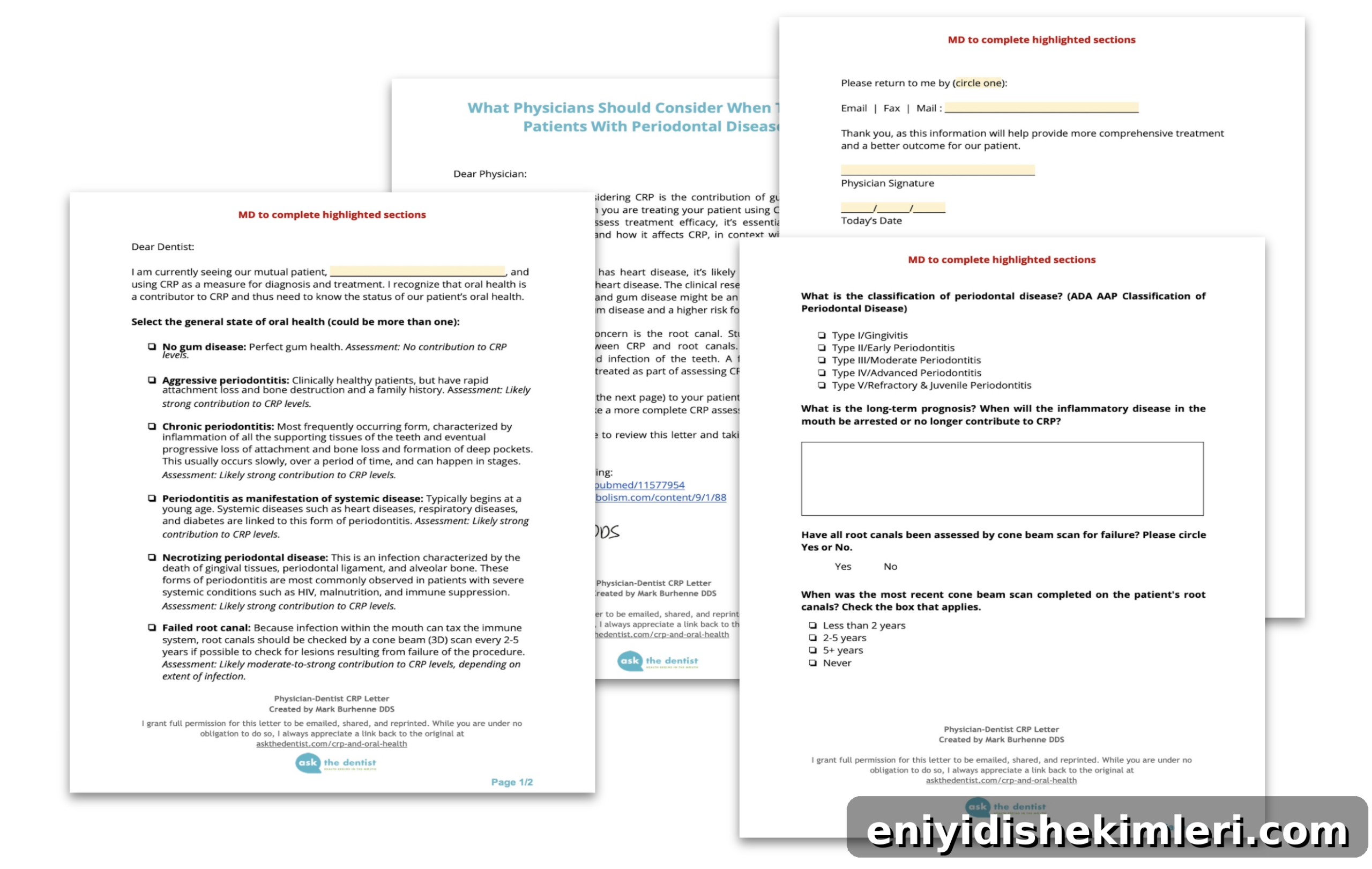
Download the CRP Doctor’s Letter
I created this CRP letter to help bridge communication between medical and dental providers when addressing patient inflammation.
This letter has helped thousands of patients coordinate care between dentists and physicians. Simply print it and bring it to your next appointment. Healthcare practitioners are welcome to distribute and use it.
Even when gum disease is already known, lack of communication between your dentist and doctor can allow this important information to be overlooked.
Multiple studies suggest the association between CRP and periodontal disease may be an important link in understanding how gum disease increases cardiovascular risk. It’s possible that oral inflammation contributes to systemic disease, a connection often missed by both dentists and physicians.
The mouth is one of the most commonly overlooked sources of chronic inflammation. Make sure it’s included in your evaluation and treatment plan.
Mark Burhenne DDS
References
Noack, B, et al. “Periodontal infections contribute to elevated systemic C-reactive protein level.” National Center for Biotechnology Information. U.S. National Library of Medicine, Sept. 2001.
Marchetti, et al. “Periodontal Disease: The Influence of Metabolic Syndrome.” Nutrition & Metabolism, 25 Sept. 2012.
Learn More:Brushing and Flossing Prevent Heart Disease: New Study