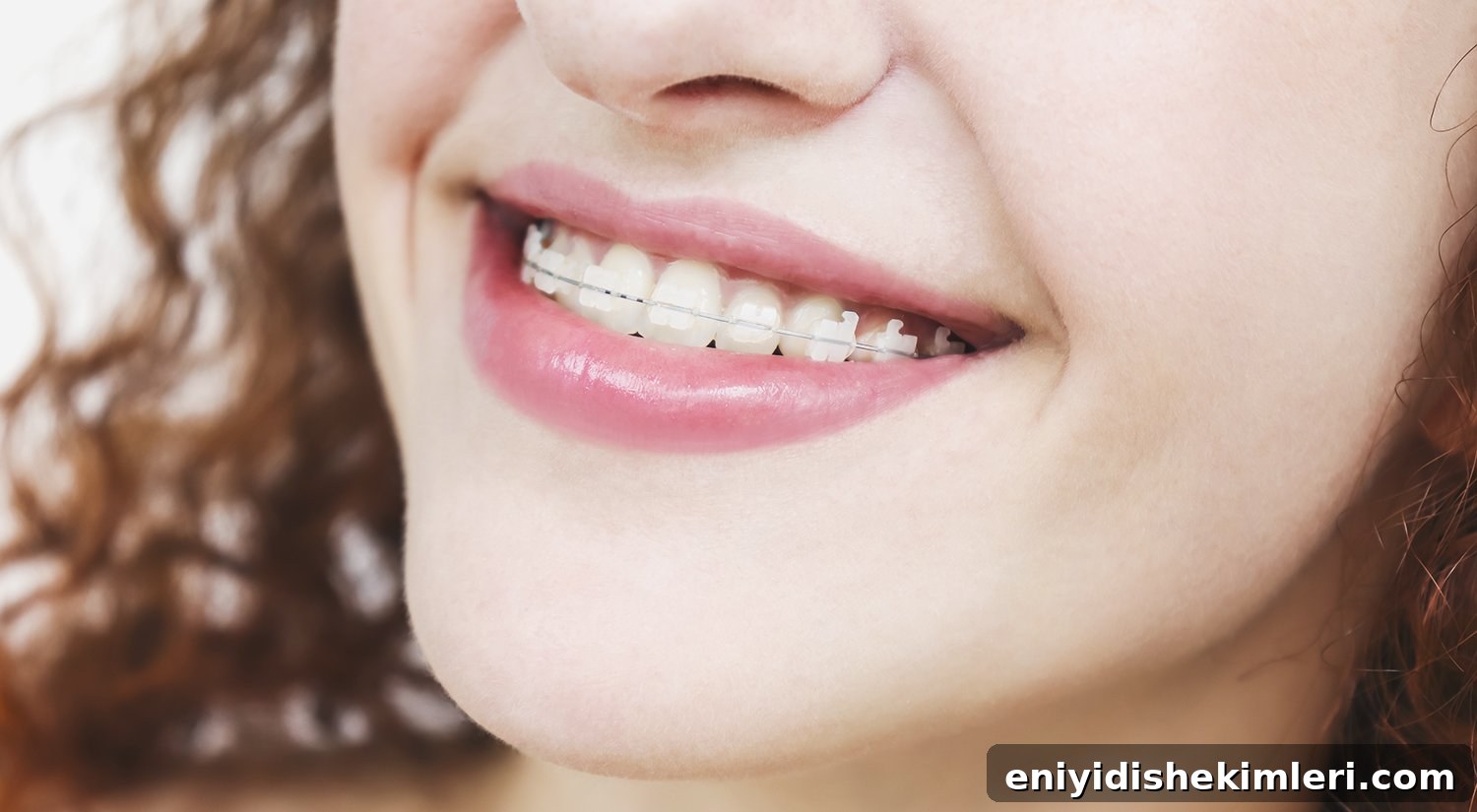
Ceramic braces were developed as an orthodontic option for people who want a less noticeable alternative to stainless steel braces. These clear or tooth-colored brackets blend in more naturally with the teeth than traditional metal brackets.
About ten years ago I underwent adult orthodontic treatment and tested ceramic brackets on my upper teeth while using metal brackets on my lower teeth. Based on that personal experience and my work as a dentist, I no longer recommend ceramic braces for most patients.
Below is a clear overview of what ceramic braces are, who may benefit from them, their advantages and disadvantages, expected treatment time, and typical costs.
What are ceramic braces?
Ceramic braces are an orthodontic treatment that works like traditional metal braces but uses brackets made from a ceramic-like composite. These brackets are either transparent or colored to match the teeth. Ceramic braces use the same archwires and elastic ligatures as metal braces and are attached to the front surfaces of the teeth.
Treatment time with ceramic braces is generally similar to metal braces—commonly around 18–24 months depending on the complexity of the case. Orthodontists or general dentists may offer ceramic braces to adolescent or adult patients.
Braces move teeth by applying controlled forces to reposition them into a more functional alignment. Correcting malocclusion improves oral hygiene effectiveness and can reduce jaw joint (TMJ) pain related to bite problems.
Benefits of ceramic braces
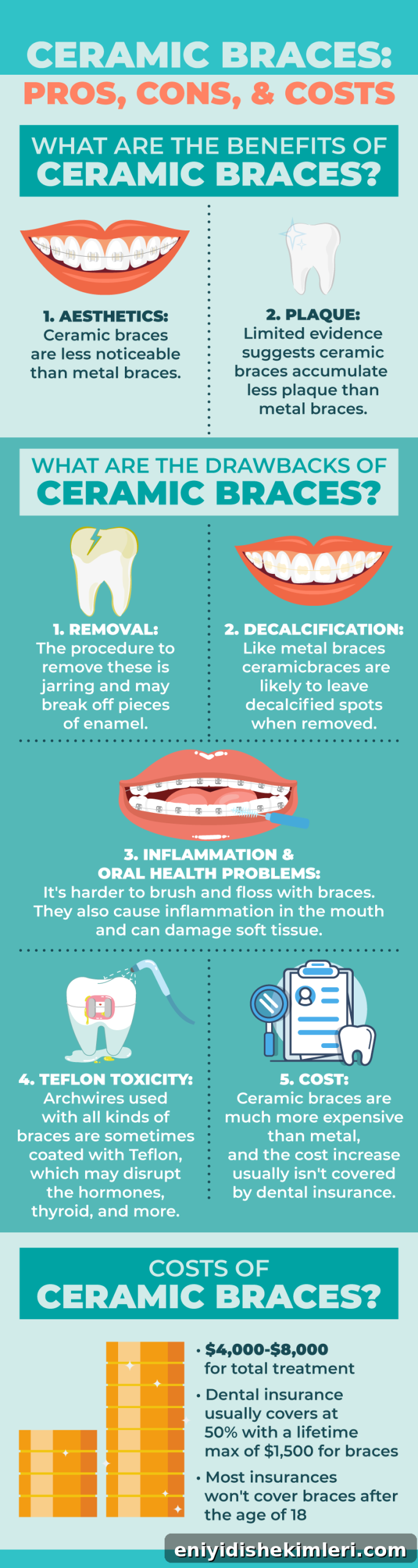
The primary advantage of ceramic braces is aesthetics: they are less visually obvious than metal brackets. For many adults and teens who are concerned about appearance, ceramic brackets can provide a cosmetic benefit during treatment.
Some limited research suggests ceramic brackets may accumulate less plaque than metal brackets, but the evidence is small and not definitive.
Cons of ceramic braces
From both a dentist’s and a patient’s perspective, ceramic braces have several notable drawbacks:
- Bracket removal: Removing ceramic brackets can be noisy and jarring. Unlike metal brackets that can often be peeled off more gently, ceramic brackets are typically “popped” off, which some patients find unpleasant. In rare cases removal can damage the underlying enamel.
- Decalcification: Like metal braces, ceramic brackets can lead to white spot lesions (decalcification) where plaque accumulates around brackets. These marks are difficult to reverse and can remain after treatment.
- Oral health challenges: Fixed braces—ceramic or metal—make brushing and flossing harder and increase the risk of inflammation, gingivitis, tooth decay, and possible root resorption. Clear removable aligners reduce many of these hygiene difficulties because they can be taken out during cleaning.
- Archwire coatings: Ceramic brackets still require metal archwires to move teeth. Some archwires have Teflon or other coatings; while coated wires can reduce friction, concerns have been raised in the literature about potential systemic effects of perfluorinated compounds. Discuss wire materials and risks with your clinician if you have concerns.
- Cost: Ceramic braces are generally more expensive than metal braces. Insurance typically covers a portion of orthodontic care but may not cover the premium cost of ceramic brackets, and using a higher-cost option can impact lifetime insurance limits for orthodontics.
Metal or ceramic—which should you choose?
For many patients, ceramic braces are not the optimal choice. Clear aligners such as Invisalign or ClearCorrect often provide superior aesthetics and allow easier oral hygiene, while traditional metal braces remain the most durable and cost-effective fixed option. Metal brackets are less likely to cause enamel damage during removal and typically cost less than ceramic brackets.
Treatment duration
Ceramic braces usually require about 18–24 months to complete treatment for most patients, similar to metal braces. Individual treatment time varies with the severity of the case, biology of tooth movement, and patient compliance.
Costs and insurance coverage
Ceramic braces typically cost roughly $4,000–$8,000 for the full course of treatment. That price range overlaps with Invisalign and is generally higher than traditional metal braces by several hundred to about $1,000 on average.
Many dental insurance plans offer partial orthodontic benefits—often around 50%—but place a lifetime maximum (commonly about $1,500). Coverage may be age-limited, with fewer or no benefits for adults in some plans.
Other types of braces to consider
Common orthodontic options include:
- Metal braces
- Ceramic braces
- Lingual braces (brackets on the back of the teeth)
- Clear aligners (Invisalign, ClearCorrect, and similar systems)
Metal braces
Traditional metal braces are durable and effective for a wide range of movements. They are usually less expensive than ceramic or lingual systems but present the same oral hygiene challenges and potential for soft-tissue irritation.
Ceramic braces
Ceramic brackets offer cosmetic benefits but are generally less durable than stainless steel and may be more likely to chip or cause enamel issues during removal. If you play contact sports or are very active, protect your mouth with a mouthguard to reduce the risk of bracket damage. Some advanced removal techniques, such as laser-assisted debonding, aim to minimize enamel risk.
Claims that ceramic brackets move teeth faster than metal brackets lack strong clinical support. Overall, ceramic treatment is typically about $1,000 more than metal treatment.
Lingual braces
Lingual braces are fixed to the backside of teeth, making them invisible from the front. They can interfere with speech more than labial brackets and generally cost significantly more, in some cases up to $13,000 depending on complexity and provider.
Clear aligners
Clear aligners are a convenient, removable option that maintains oral hygiene and avoids bracket removal issues. They are visually discreet and eliminate many concerns associated with fixed braces. Professional clear-aligner treatment typically ranges from $3,000–$8,000; direct-to-consumer at-home systems are often less expensive, usually between $1,500–$3,000.
FAQs
Q
Is it possible to stain ceramic braces?
A
Yes. Ceramic brackets and the elastic ligatures around them can discolor with exposure to strongly pigmented foods and beverages such as coffee, red wine, curry, and smoking. To reduce staining, limit these foods and drinks, avoid tobacco products, and follow your clinician’s advice on maintenance.
Q
What is the removal process like for ceramic braces?
A
Ceramic brackets are typically removed by applying a force that causes them to separate from the adhesive, which can feel and sound like a pop. Some patients find this uncomfortable and there is a small risk of enamel damage during debonding. Discuss removal techniques and risks with your orthodontist beforehand.
References
- Lindel ID, Elter C, Heuer W, et al. Comparative analysis of long-term biofilm formation on metal and ceramic brackets. The Angle Orthodontist. 2011;81(5):907-914.
- Azaripour A, Weusmann J, Mahmoodi B, et al. Braces versus Invisalign®: gingival parameters and patients’ satisfaction during treatment: a cross-sectional study. BMC Oral Health. 2015;15(1):69.
- Farronato G, Maijer R, Carìa MP, et al. The effect of Teflon coating on the resistance to sliding of orthodontic archwires. European Journal of Orthodontics. 2012;34(4):410-417.
- Fei C, McLaughlin JK, Lipworth L, Olsen J. Maternal levels of perfluorinated chemicals and subfecundity. Human Reproduction. 2009;24(5):1200-1205.
- Melzer D, Rice N, Depledge MH, Henley WE, Galloway TS. Association between serum perfluorooctanoic acid (PFOA) and thyroid disease in the US National Health and Nutrition Examination Survey. Environmental Health Perspectives. 2010;118(5):686-692.
- Jena AK, Duggal R, Mehrotra AK. Physical properties and clinical characteristics of ceramic brackets: a comprehensive review. Trends Biomater Artif Organs. 2007;20(2):101-115.
- Ghazanfari R, Nokhbatolfoghahaei H, Alikhasi M. Laser-aided ceramic bracket debonding: a comprehensive review. Journal of Lasers in Medical Sciences. 2016;7(1):2.
- Rai AK, Rozario JE, Ganeshkar SV. Comparison of speech performance in labial and lingual orthodontic patients: A prospective study. Dental Research Journal. 2014;11(6):663.