Dental decay is one of the most common oral health problems affecting children worldwide. If left untreated, decay can cause premature loss of primary teeth, which may negatively impact appearance, speech development, and chewing function.
Pulpotomy is a common pediatric dental procedure used when decay is limited to the crown portion of a primary tooth and has not reached the roots. The procedure preserves the healthy root pulp after removing the infected coronal pulp tissue.
Formocresol, a mixture containing formaldehyde and tricresol, has been used as a pulpotomy medicament for decades. Its longstanding acceptance is largely due to ease of use and strong bactericidal properties.
Low-level laser therapy (LLLT) is recognized for anti-inflammatory and analgesic effects, and some studies indicate it can modulate healing and immune responses. This study compared the clinical and radiographic outcomes of LLLT with formocresol when used as pulpal dressings in primary molars.
Study Details
This split-mouth, randomized clinical trial was conducted at the Pediatric Dentistry Clinics of King Abdulaziz University, Jeddah, Saudi Arabia, between August 1, 2016, and August 31, 2017.
Participants were children aged five to eight years who had deep carious lesions requiring pulpotomy on at least one primary molar on each side of the mouth.
Inclusion criteria for teeth were:
- Decay confined to the crown that could be restored.
- No clinical signs of swelling, pathological mobility, or spontaneous pain.
- No radiographic evidence of periapical or interradicular pathology.
Of 50 screened children, 36 met the criteria. A total of 106 primary molars were eligible and randomized: 53 teeth received LLLT and 53 received formocresol (FC).
Pulpotomy Procedure
Topical anesthetic gel was applied to the gingiva followed by local anesthesia. Teeth were isolated with a rubber dam and appropriate clamp, and decay was removed. The coronal pulp was removed with a spoon excavator. Hemostasis was achieved by irrigating the pulp chamber with distilled water and placing a saline-dampened cotton pellet for about five minutes.
1. Low-Level Laser Therapy (LLLT) Group
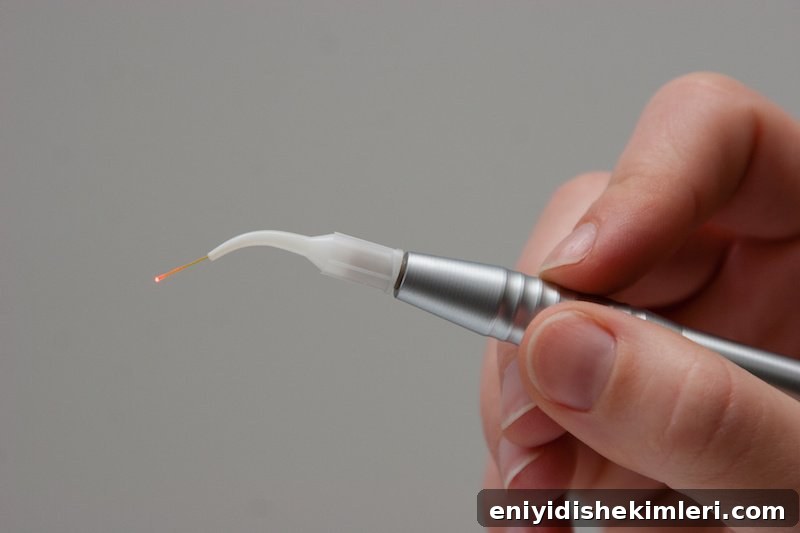
In the LLLT group, the pulp chamber was irradiated with an 810 nm diode laser for 40 seconds using a 200 µm optical fiber. The fiber tip was held approximately 2 mm from the pulp surface and moved to expose all areas of the chamber.
2. Formocresol (FC) Group
For the FC group, a cotton pellet moistened with a 1:5 diluted formocresol solution was placed in the pulp chamber for about five minutes. Afterward, the chambers in both groups were filled with a reinforced zinc oxide–eugenol temporary restoration. In a subsequent appointment, the temporary was replaced with glass ionomer cement and a stainless steel crown was placed.
Clinical and radiographic follow-ups were performed at six months and one year. Evaluations looked for symptoms such as sensitivity, pathological mobility, pain, or swelling and for radiographic signs like periapical or furcal pathology. No clinical or radiographic signs of failure were observed in the treated teeth during the follow-up periods.
Results and Interpretation
Both LLLT and formocresol groups showed favorable clinical and radiographic outcomes at six months and one year, indicating comparable success rates for pulpotomy in primary molars when selection criteria are met.
Discussion
LLLT may enhance wound healing and promote calcific barrier formation at the treatment site. Potential advantages of LLLT in pulpotomy include:
- Minimally invasive application
- Shorter chairside time
- Promotion of tissue regeneration
- Reduced postoperative hypersensitivity
- Analgesic effects that can minimize procedure-related pain
Formocresol effectively devitalizes residual coronal pulp but has been associated with undesirable effects on remaining root pulp tissue and poses concerns due to its formaldehyde content. For these reasons, clinicians often use diluted solutions and remain cautious about long-term systemic effects.
While this trial found similar short-term outcomes between LLLT and formocresol, larger studies with longer follow-up are needed to confirm whether LLLT can replace traditional medicaments as a routine pulpotomy treatment in pediatric dentistry.
Conclusion
Pulpotomy remains the treatment of choice for primary molars with carious involvement limited to the coronal pulp. In this randomized split-mouth trial, both LLLT and diluted formocresol achieved comparable clinical and radiographic success at one year. LLLT offers additional benefits of being less invasive and faster to apply, but further research with larger samples and extended follow-up is required before it can be universally recommended as a standard pulpotomy dressing.
Mark