
I’m pleased to have myofunctional therapist Sarah Hornsby on the blog today to discuss mouth breathing. Many people don’t realize how profoundly mouth breathing can affect a child’s health and development. Sarah’s article explains why mouth breathing deserves attention and offers straightforward strategies parents can use.
I’ve followed Sarah’s work for some time, which is why I invited her to contribute a section on myofunctional therapy to my book, The 8-Hour Sleep Paradox. She also maintains a useful YouTube channel for anyone wanting to learn how myofunctional therapy can stop mouth breathing, correct a reverse swallow (tongue thrust), and improve sleep. If you want personalized help, Sarah offers a free 30-minute Skype consultation through her website and works with patients worldwide. —Dr. B
A mother watches her seven-year-old daughter coloring. As the girl concentrates on the petals, the mother notices her lips are parted. She looks at her son and sees his lips are closed.
Is this a harmless quirk or a sign of a serious breathing issue?
Most people don’t understand that mouth breathing is more than a minor habit. As a myofunctional therapist, I hear examples like this frequently.
If your child breathes through their mouth, they can learn to change that habit. My role is to help patients relearn nasal breathing and proper oral posture. Teaching nasal breathing instead of mouth breathing can prevent many long-term problems, including sleep-disordered breathing, speech issues, and altered facial growth.
Terminology
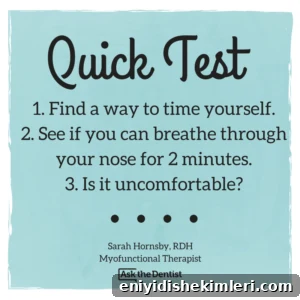 Some people simply rest with their mouths open; for others the mouth is open because they are using it to breathe. We refer to these patterns as an “open mouth resting posture” or simply “open mouth.”
The natural, healthy breathing position is with the mouth closed and all breathing done through the nose.
Some adults are aware of an open-mouth habit, while others only discover it during an evaluation. Adult patients are often embarrassed and frustrated by their inability to keep their lips together when they are not talking or eating.
Does Mouth Breathing Actually Matter That Much?
Although an open mouth may look like a trivial concern, it can have significant consequences. It’s not merely cosmetic or easy to fix—mouth breathing affects function, development, and long-term health.
The Serious Health Effects of Mouth Breathing
- Teeth and orthodontics: Mouth breathing makes orthodontic care more difficult. Braces may take longer to work, closing spaces becomes harder, and alignment tends to be less stable after treatment. This increases the risk of relapse and possibly needing braces again.
- Speech: Children who keep their mouths open often develop a tongue-thrust swallow, which pushes the tongue forward during speech and swallows. This pattern commonly leads to lisps and difficulty producing correct “S” sounds.
- Facial growth and development: Growth is powerful. Children who mouth-breathe are more likely to develop longer, narrower faces with flatter cheekbones, lower facial muscle tone, droopier eyes, a narrowed palate, and sometimes a smaller lower jaw. Encouraging closed-mouth nasal breathing can prevent many of these negative growth patterns.
- Sleep and oxygenation: Daytime mouth breathing usually continues at night. Nighttime mouth breathing, especially when combined with airway obstruction, is closely linked to sleep apnea and abnormal oxygen and carbon dioxide levels. Reduced oxygen delivery to the brain can impair learning and attention in children; adults often experience chronic fatigue, brain fog, and poor concentration.
When patients are referred to my practice, referrals most often come from orthodontists, but also from ENTs, pediatric dentists, general dentists, chiropractors, speech pathologists, allergists, and other specialists. Regardless of the referral source, the first issue I examine in every patient is whether they have an open mouth resting posture.
Megan’s Story: Seeing a Myofunctional Therapist for the First Time
When Megan came for an evaluation, I asked her mother about allergies and nasal congestion because chronic nasal blockage forces a child to breathe through the mouth. Megan was allergic to cats and certain pollens, providing a clear starting point for treatment.
After identifying the cause of her mouth breathing, we coordinated care with an allergist and her pediatrician to manage symptoms. Once Megan could breathe through her nose, I taught exercises to retrain her tongue and oral muscles so her lips could rest closed naturally. She also needed guided practice to use her nasal passages after seven years of mouth breathing.
Two years later, Megan is a happy nine-year-old who breathes through her nose and maintains a closed-mouth resting posture. She may need orthodontic treatment later, but if so, it should be straightforward. Her facial and airway growth are now on a healthier trajectory.
What Causes an Open Mouth or Mouth Breathing Habit?
Determining what started an open mouth habit can be tricky. Most cases involve one or more of these common factors:
- Breathing or airway problems: Allergies, chronic nasal congestion, enlarged tonsils or adenoids, asthma, and a deviated septum are common contributors. Even after airway obstruction is treated, the mouth-breathing habit often persists and requires myofunctional therapy to retrain muscles and breathing patterns.
- Thumb or finger sucking: Extended sucking alters oral and facial muscle development, prevents a proper lip seal, and promotes tongue-thrust swallowing. Stopping the sucking habit does not always resolve mouth breathing—myofunctional therapy and orthodontics are frequently needed afterward.
- Tongue-tie (restricted lingual frenum): This documented medical condition limits tongue mobility and can prevent a natural tongue posture that supports nasal breathing. Some patients benefit from a simple release procedure plus targeted exercises before and after surgery to restore nasal breathing and a closed-mouth posture.
What Parents Can Do to Prevent Mouth Breathing
Now that you know the signs, you can monitor yourself and your child and take steps early. Start with these actions:
- Watch for mouth breathing or a persistent open-mouth resting posture. Note how often it happens during the day.
- Assess whether there is a history of airway issues such as allergies, chronic nasal congestion, enlarged tonsils/adenoids, or asthma.
- Consider consulting a physician or a dentist who specializes in breathing and sleep. A sleep study—either at home or in a clinic—may be appropriate, and a clinician can guide you on the best option.
- Schedule an evaluation with a myofunctional therapist. We screen for oral posture, breathing, and swallowing patterns and can help direct you to the right specialists and treatments.
Sarah Hornsby, RDH
Learn More:When Should My Child First See the Dentist?
Want to learn more? Check out my #1 Amazon bestselling book, The 8-Hour Sleep Paradox.
 This book outlines practical steps to improve sleep quality so you can become your healthiest, most focused self.
The three-step program helps you work toward goals such as:
- Achieving a healthy weight by naturally regulating appetite
- Slowing visible aging and promoting restorative sleep
- Waking refreshed and alert each morning
- Improving energy, concentration, and mental clarity
- Eliminating daytime sleepiness and brain fog
Get your copy now!